 |
Tuesday, March 8, 2016
Unknown Acid Lab
This week, we've been working on another titration lab that is pretty much identical to last week's Acetic Acid lab. The only thing that's changed is that we're not using acetic acid, but an unknown acid. We still titrated the unknown acid with NaOH, just like the acetic acid lab. Another thing that's been added to this lab is that we have to heat the solution as the unknown acid does not dissolve as easily as acetic acid. It's pretty neat seeing the solution turn into a mini tornado when the magnet is added to the flask and spins due to the magnet in the heater.

Titration Lab
We've been working on a new lab. The purpose of the lab is to standardize a solution of NaOH with KHP, and then, use that solution's molarity to determine the percentage of acetic acid is in vinegar. To start, we filled the buret with NaOH, and measured out some KHP on a weigh boat. We transfered the KHP to a flask, and filled it with water to make a solution of 75 mL. Next, we added three drops of phenolphthalein to act as a color indicator for the endpoint. Lastly, we slowly drained the NaOH solution into the flask until the solution reached a permanent pink color. This was the hard part as we never knew exactly when to stop, but then again, we couldn't go too slowly as we needed to finish within a class period.

Acid-Base Quiz
 |
| http://www.sciencegeek.net/APchemistry/APtaters/pHcalculations.htm |
First Acid-Base Lecture
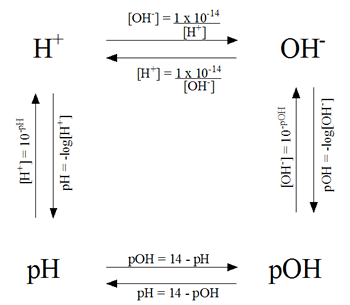
We started our new unit on acids & bases. So far, the majority of the lessons are not very complex nor difficult to understand. I may just need to study some of the vocab again. The lecture consisted of identifying the differences between acids and bases, strong vs. weak, and Arrhenius vs Bronsted-Lowry acids. This was probably the most difficult out of the two lectures we've had so far as it was very vocab-packed, and there are some rules that need to be memorized in order to identify what type of acid or base a substance is. Today's lecture was more math based in that we had. It was basic math and involved a simple formula to find the M of either H or OH ions in a reaction.
Vitamin C Lab
We did the Vitamin C lab. My pre lab question was a math one, and it really wasn't hard at all. You just needed to know the formula of calculating concentration by dividing the drops of iodine needed to reach the endpoint of the sample over the drops of iodine needed to reach the endpoint of the standard. The actual lab consisted of measuring the number of drops of iodine were needed to reach the endpoint (when the solution turned permanently blue) of various fruit juices: pear, apple, grapefruit, v8. We then compared these numbers to the number of drops needed to reach the endpoint of a standard Vitamin C solution, made by a dissolved 500mg Vitamin C tablet in 500mL of water. We performed 3 trials while everyone else mostly performed 2 trials. This was to make sure we were being extra accurate, but when we actually looked back at our data for the trials, it seemed as if that extra trial just threw the average off. For example, the standard solution had endpoints of 39, then 27, and finally in the 3rd trial, it had an endpoint of 55. So, it totally threw off the average of the endpoint of the solution. This was probably due to the fact that we did the third trial on the second day of lab, when we had a new standard made. The standard was most likely much different than the standard from day one, throwing our number off.

Helpful links
https://www.youtube.com/watch?v=KVZ_KS45rVg
http://chemcollective.org/activities/tutorials/stoich/solution_stoi
https://chemistry11mrstandring.wikispaces.com/Stoichiometry+Calculations+Involving+Molar+Concentration
http://www.quansysbio.com/dilutions
https://www.youtube.com/watch?v=rPND65LPwS0&feature=youtu.be
http://www.chemteam.info/Solutions/Molarity.html
http://chemcollective.org/activities/tutorials/stoich/solution_stoi
https://chemistry11mrstandring.wikispaces.com/Stoichiometry+Calculations+Involving+Molar+Concentration
http://www.quansysbio.com/dilutions
https://www.youtube.com/watch?v=rPND65LPwS0&feature=youtu.be
http://www.chemteam.info/Solutions/Molarity.html
Molarity in Stoichiometry
 |
| http://employees.csbsju.edu/hjakubowski/classes/Chem%20and%20Society/stoichiometry/olstoichiometry.htm |
Subscribe to:
Posts (Atom)